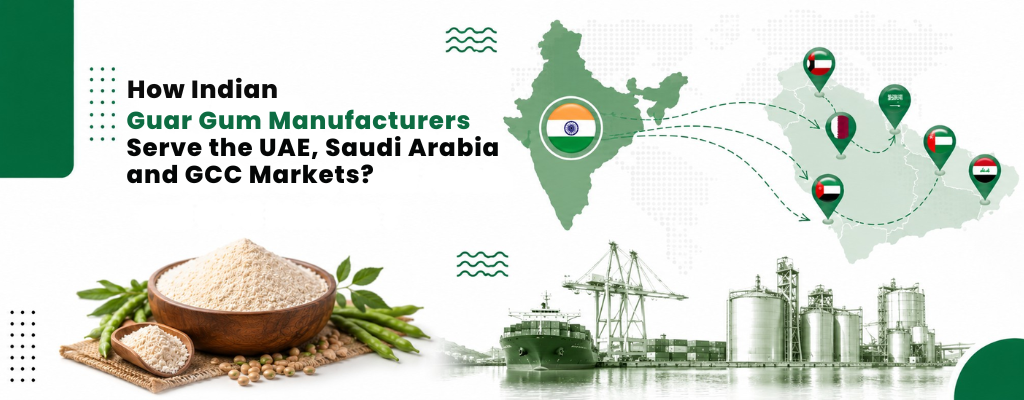
Walk through a modern food factory in Dubai, an oilfield in Saudi Arabia, or a pharmaceutical plant in Oman, and you will likely encounter an ingredient sourced thousands of kilometers away—India. Guar gum powder, a natural thickening and stabilizing agent, has become essential across multiple industries in the Middle East. Behind this steady supply is a well-established network of guar gum powder manufacturers in India who understand the technical, commercial, and regulatory needs of GCC buyers.
This article explains how Indian manufacturers successfully serve the UAE, Saudi Arabia, and broader GCC markets, why India dominates global supply, and what importers should look for when choosing a reliable guar gum powder supplier.
Guar gum powder is derived from guar beans and valued for its high viscosity, binding ability, and cost efficiency. These properties make it indispensable across key GCC sectors.
Food & beverages: Improves texture in bakery items, sauces, dairy products, and gluten-free foods
Oil & gas: Acts as a gelling agent in hydraulic fracturing fluids
Pharmaceuticals: Used as a binder and controlled-release agent
Cosmetics & personal care: Enhances consistency in creams and shampoos
Textiles & paper: Serves as a thickener and sizing agent
With GCC countries importing over 70% of their hydrocolloids, guar gum powder remains a strategic raw material.
Actionable takeaway: Importers should define end-use requirements clearly, as food-grade and industrial-grade guar gum differ significantly in processing and compliance.
India accounts for nearly 80% of global guar production, making it the world’s largest exporter. This dominance is not accidental.
Ideal agro-climatic conditions in Rajasthan, Gujarat, and Haryana
Decades of farming expertise and established supply chains
Advanced processing infrastructure near ports
Competitive pricing without compromising quality
These factors allow Indian guar gum powder exporters to scale production while maintaining consistency.
Practical insight: Large GCC buyers often prefer Indian suppliers because they can handle both bulk industrial orders and specialized food-grade batches.
Leading guar gum powder manufacturers offer tailored specifications based on application:
Viscosity levels adjusted for oilfield or food use
Mesh size customized for faster hydration
Low microbial counts for pharmaceutical and food sectors
This customization is critical for GCC markets, where regulatory scrutiny is high.
Indian manufacturers exporting to the Middle East typically comply with the following:
Gulf Standards Organization (GSO) norms
SFDA (Saudi Food and Drug Authority) requirements
Halal certification for food applications
ISO, HACCP, and FSSC 22000 standards
Such compliance reduces customs delays and ensures smoother market entry.
Actionable takeaway: Always request full documentation (COA, MSDS, Halal certificate, and origin certificate) before finalizing a supplier
India’s west coast ports Mumbai, Mundra, and Kandla offer direct shipping routes to Jebel Ali, Dammam, and other GCC ports. This enables:
Shorter transit times (typically 10–18 days)
Reduced freight costs
Better inventory planning for GCC importers
Reliable exporters also maintain buffer stock to manage seasonal fluctuations in guar bean harvests.
Reputed Indian guar gum powder suppliers focus on long-term contracts rather than opportunistic spot sales. Companies such as Abdullabhai Abdul Kader (Mumbai) built trust by consistently meeting delivery schedules and quality benchmarks for Middle Eastern clients.
Practical tip: Long-term supply agreements help GCC buyers stabilize pricing in a volatile agricultural commodity market.
Top Indian manufacturers implement end-to-end traceability:
Contract farming or vetted raw material sourcing
Controlled dehusking and splitting processes
In-house grinding and hydration testing
Batch-wise laboratory analysis
This level of control ensures uniform performance in demanding applications like oil drilling or dairy processing.
Many exporters conduct SGS or Intertek testing to validate viscosity, moisture, and microbial limits, an added assurance for Saudi and UAE importers.
Actionable takeaway: Choose suppliers with in-house labs and third-party validation to reduce operational risk.
Match grade to application: Food-grade standards differ sharply from industrial grades
Evaluate consistency, not just price: Cheaper guar gum can lead to formulation failures
Check export experience to GCC: Familiarity with Middle Eastern documentation matters
Assess communication and responsiveness: Time-zone alignment and clarity reduce errors
Rising food processing investments, expanding oilfield activity, and growing pharmaceutical demand indicate steady growth for guar gum imports in the GCC. Indian manufacturers are responding by:
Investing in cleaner processing technologies
Developing fast-hydrating and enzyme-modified variants
Strengthening regional distribution partnerships
This evolution positions India as not just a supplier but a strategic partner to Middle Eastern industries.
Indian guar gum manufacturers play an important role in supplying the UAE, Saudi Arabia, and GCC markets with reliable, high-quality guar gum powder. Their dominance stems from agricultural strength, technical expertise, regulatory compliance, and efficient logistics. For GCC buyers, partnering with experienced guar gum powder manufacturers in India ensures consistent quality, cost efficiency, and long-term supply security.
By selecting the right supplier, aligning specifications with end-use needs, and prioritizing quality over short-term savings, importers can unlock the full value of this versatile natural ingredient.