A customer from middle wast, recently sent us a bad week’s work. A batch of turmeric fingers were delivered from India. They were pale in colour, and the curcumin content tested at 2.8% (when it should have been 5%). Additionally, there was a customer waiting at retail.
Although this situation was not fraudulent, it was due to not asking the correct questions before placing an order.
This story is very common amongst new buyers of turmeric fingers from India. Although India is the dominant producer of Turmeric in the world, knowing what supplier, variety and documentation to go for can make finding a reliable source difficult.
The short version:
India supplies most of the world's turmeric, with varieties suited to everything from curry powder to supplements.
Reliable suppliers share lab reports, licenses, and samples before you commit.
Match the variety to your end use, and test every lot.
Book during or just after the January to April harvest for the freshest stock.
India grows and consumes more turmeric than any other country and supplies most of what the world exports. Its farmers cultivate dozens of varieties across several states, which gives buyers a wide range of curcumin levels, colors, and price points. That depth is the main reason importers keep returning to Indian origin.
The evidence points to scale and variety working together. A buyer in Dubai chasing deep orange color for retail powder and a supplement brand in Germany chasing curcumin concentration can both find what they need in the same country.
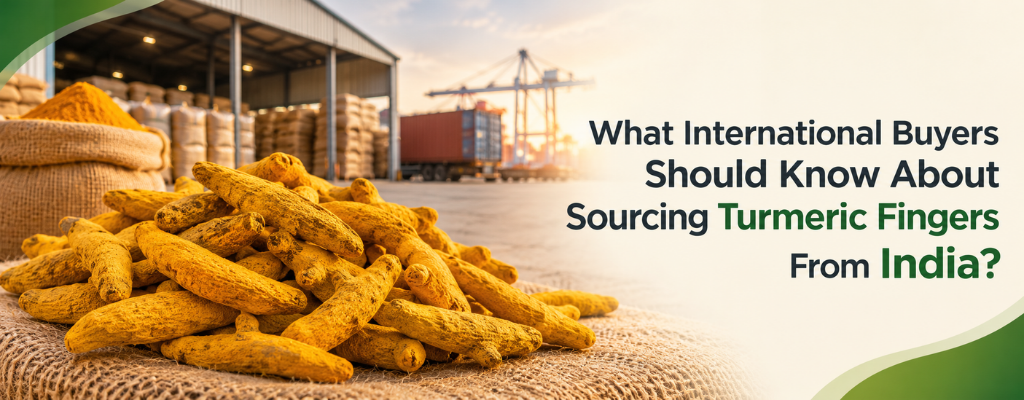
Turmeric fingers are the dried, cured side rhizomes of the plant. They are the preferred form for grinding because they carry more of the aroma and pigment than the larger "bulb" pieces.
Trusted turmeric finger suppliers will be able to provide you with certifications, test results and source of origin (farm/mandi). They should also be happy to answer technical questions. Check that they have an export licence, and ask to see recent analysis certification, and a pre-shipment sample. If they cannot do this, they are telling you something!
Here is a practical screening routine:
Verify the company's Import Export Code and food safety license.
Ask where the raw turmeric is sourced and how it is stored.
Request a certificate of analysis from the most recent lot.
Order a sample and test it at your own lab.
Start with a small trial order before a full container.
We have seen buyers skip step four because the sample "looked right." Color is only part of the story. Lead-based adulterants and artificial dyes have shown up in the turmeric trade over the years, and the eye cannot catch them. Only a lab can.
Depending on requirements, different turmeric varieties can be used. If your requirement is high levels of curcumin in extracts/supplements then you may wish to choose Alleppey or Lakadong. For colour and use in cooking, Salem and Erode fingers are suitable. For softer flavours in food, Rajapuri (grown primarily in Maharashtra) may be suitable.
Approximate guidance:
Lakadong (Meghalaya) – very high levels of curcumin. Suitable for well being/health products.
Alleppey (Kerala) – Good colour and high curcumin. Popular for high quality powder.
Salem and Erode (Tamil Nadu) – Consistent colour and quantity. Common in commercial spice blends.
Rajapuri and Sangli (Maharashtra) – Softer flavour. Lower cost. Good for general cooking uses.
There is more than one type of turmeric! If you do not specify which variety of turmeric you would like and what curcumin level you require, it is left to chance.
Check for % Curcumin, moisture content, ash content, heavy metals, pesticide residues, aflatoxin levels and microbial content. Moisture content should be between 10-12% for whole fingers. It is best to have this analysis done by an accredited lab using your specific batch. If possible.
The importing countries can be very strict. Pesticide residues and mycotoxins frequently get shipments of spices rejected in Europe. It will cost much more money to get a shipment rejected than just pay a few extra analysis costs.
Include the below checks in all orders:
Curcumin content agreed in writing before shipment
Moisture and ash limits
Pesticide and heavy metal results meeting your destination country's limits
Absence of artificial colorants
Microbial and aflatoxin screening
Commercial invoice, packing list, bill of lading, certificate of origin and phytosanitary certificate are typically required. You may also be required to provide additional documentation depending on your destination market (FDA prior notification in the US and lab tests in EU). Check with your customs broker in advance of the container being shipped to ensure that documentation is complete.
If you are exporting to a retailer or private label brand, you may wish to get certifications such as HACCP, ISO 22000 or organic. This demonstrates that the supplier follows a defined process.
Example: A shipment of fingers has been imported into the UK. As a phytosanitary certificate wasn’t requested, the product was delayed for 9 days at the port. This led to significant margins being lost due to demurrage.
Fingers allow quality control and fresh produce. Powder is quicker to process. If you have in house grinding or want to visually check raw product, buy in finger form. If you require uniform product quickly and do not have the milling capacity, buy in powder form from a reputable turmeric powder exporter .
Some customers buy both products. High quality products with traceability are purchased in finger form, and high volume blends in powder form.
If purchasing in powder form, find out what measures are in place to avoid high temperatures and contamination during milling. Excessive heat will reduce aroma and colour..
Fresh harvest runs roughly from January to April, and new-crop fingers reach the market soon after boiling and drying. Prices tend to soften when arrivals peak. Buyers who book in the first quarter often get the freshest stock and better negotiating room.
Plan lead time too. Between sampling, testing, production, inspection, and shipping, a first order can easily take six to ten weeks. To summarize the data from buyers we speak with, those who rush this timeline are the ones who report the most problems.
It varies by supplier. Many exporters ship in 20-foot containers, but some accept smaller trial lots of a few tonnes. Ask for a sample order first so you can test quality before committing to volume.
Request a heavy metal test and a colorant screening from an accredited lab on the specific lot. Reputable suppliers share these willingly. Natural turmeric also has a characteristic earthy aroma that dyed product lacks.
Properly dried fingers stored in a cool, dry place in sealed, food-grade packaging stay usable for 12 to 24 months. Moisture is the main enemy, so keep warehouse humidity low.
Yes. Look for certification under India's organic program or recognized international standards, and ask for the current certificate with its validity date.
Samples can be provided. Full container quantities can be supplied once the parameters below have been matched:
Variety
Curcumin Content
Moisture
Packaging
For a supplier to go through all these steps with you, go to www.aakmum.com and ask for samples and a certificate of analysis. It takes just a few minutes to do now, saving you expensive rejections in the future!