The food industry across the Middle East has experienced remarkable growth over the past decade. Rising consumer demand for processed foods, beverages, confectionery, dairy products, and bakery items has increased the need for high-quality food ingredients that enhance visual appeal while meeting strict regulatory standards.
Among these ingredients, food colours play a vital role. Whether it's giving beverages their vibrant appearance, making confectionery more attractive, or ensuring consistency across packaged foods, manufacturers rely on premium colouring solutions to maintain product quality.
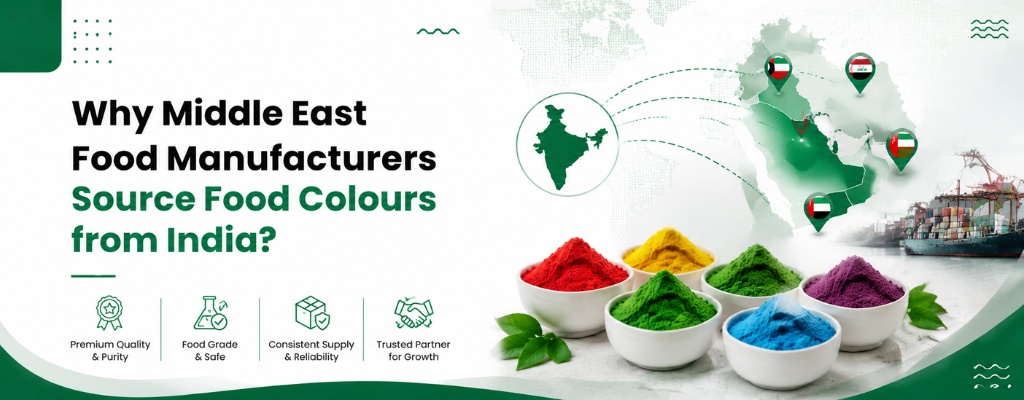
Today, many Middle Eastern businesses are turning to food colour exporters in India to meet these demands. India's reputation for quality production, competitive pricing, global certifications, and reliable exports has made it one of the preferred sourcing destinations for food colours worldwide.
This blog explores the key reasons why food manufacturers in the Middle East increasingly choose Indian suppliers and how this partnership benefits both businesses and consumers.
India has emerged as one of the world's leading producers and exporters of food ingredients. Continuous investment in manufacturing technology, quality assurance systems, and research has strengthened its position in the international market.
Many Indian food colour suppliers serve customers across the Gulf Cooperation Council (GCC) countries, including the United Arab Emirates, Saudi Arabia, Qatar, Oman, Kuwait, and Bahrain. Their ability to produce both synthetic and natural food colours according to international standards makes them reliable long-term partners.
The country's well-developed export infrastructure also enables timely deliveries to Middle Eastern markets, helping manufacturers maintain efficient supply chains.
Quality is one of the primary reasons Middle Eastern manufacturers source from India.
Leading Indian manufacturers operate facilities certified under internationally recognised standards such as the following:
ISO-certified quality management systems
HACCP food safety systems
GMP (Good Manufacturing Practices)
FSSAI compliance
Halal-certified production (where applicable)
These certifications provide confidence that products are manufactured under controlled conditions while maintaining consistency from batch to batch.
For food manufacturers producing large volumes, consistency is essential because even slight colour variations can affect product appearance and consumer perception.
Cost efficiency is another major advantage.
Indian manufacturers benefit from:
Large-scale production facilities
Skilled workforce
Strong raw material availability
Efficient manufacturing processes
Competitive operating costs
These advantages allow them to offer premium-quality food colours at highly competitive prices.
For Middle Eastern food companies operating in highly competitive retail markets, reducing ingredient costs while maintaining quality helps improve overall profitability.
Instead of sacrificing quality for lower costs, businesses can achieve both through strategic sourcing from India.
Today's consumers increasingly prefer visually appealing foods made with safe, approved ingredients.
Indian manufacturers offer an extensive portfolio that includes:
Natural food colours
Synthetic food colours
Water-soluble colours
Oil-soluble colours
Lake colours
Custom colour blends
This flexibility enables manufacturers to develop products for different market segments and consumer preferences.
For example:
Beverage companies require stable colours that perform well in acidic environments.
Bakery manufacturers need colours that remain stable during high-temperature baking.
Dairy producers seek colours that maintain consistency throughout shelf life.
Experienced Indian suppliers understand these technical requirements and recommend suitable colouring solutions for each application.
India has maintained strong trade relationships with Middle Eastern countries for decades.
This experience offers several advantages:
Experienced exporters are familiar with import documentation, packaging requirements, product registrations, and regulatory expectations across GCC countries.
This minimises delays and simplifies the procurement process.
India's major ports and well-established shipping routes ensure efficient transportation to Middle Eastern destinations.
Short transit times help manufacturers receive products faster while maintaining inventory efficiency.
No two food products have identical colouring requirements.
One of the strengths of leading Indian food colour exporters is their ability to customise solutions for specific industries.
These include:
Bakery
Confectionery
Dairy
Ice cream
Beverages
Snacks
Sauces
Processed foods
Nutraceuticals
Manufacturers often require colours with specific characteristics, such as the following:
Heat stability
Light stability
pH stability
High colour intensity
Excellent dispersion
Indian suppliers frequently collaborate with customers to develop formulations that perform optimally under real production conditions.
This technical support creates long-term business partnerships rather than simple supplier relationships.
Consumer preferences across the Middle East are changing.
Health-conscious buyers increasingly examine ingredient labels and prefer products containing naturally derived ingredients whenever possible.
To meet this demand, Indian manufacturers have expanded production of natural colours derived from sources such as the following:
Turmeric
Beetroot
Paprika
Spirulina
Annatto
Chlorophyll
These ingredients provide vibrant colours while supporting clean-label product development.
As food brands continue introducing healthier product lines, access to reliable natural colour suppliers becomes increasingly valuable.
Large food manufacturers require uninterrupted ingredient supplies throughout the year.
India's extensive manufacturing capacity enables suppliers to meet the following:
Small trial orders
Medium-volume production
High-volume industrial requirements
Whether a company is launching a new beverage brand or supplying supermarket chains across multiple countries, dependable production capacity reduces the risk of supply interruptions.
Scalable manufacturing also supports seasonal demand spikes, which are common during Ramadan, Eid, festive seasons, and tourism peaks across the Middle East.
Selecting the right supplier involves more than comparing prices.
When evaluating food colour suppliers, consider the following:
Choose suppliers with internationally recognised food safety and quality certifications.
Reliable suppliers provide product specifications, certificates of analysis, stability data, and regulatory documentation.
A knowledgeable supplier should assist with colour selection, dosage recommendations, and formulation challenges.
Suppliers with proven experience serving Middle Eastern customers are more likely to understand local compliance requirements and shipping processes.
Reliable communication, consistent quality, and dependable deliveries are often more valuable than selecting the lowest-priced option.
Several market trends suggest that sourcing from India will continue expanding.
Growing populations, increasing urbanisation, and higher consumption of packaged foods are driving demand for quality food ingredients throughout the Middle East.
At the same time, Indian manufacturers continue investing in advanced production technologies, research and development, sustainable manufacturing practices, and innovative natural colour solutions.
This combination of quality, affordability, technical expertise, and export reliability positions India as a strategic sourcing partner for food manufacturers across the region.
The decision by Middle Eastern food manufacturers to source food colours from India is driven by a combination of practical business advantages and consistent product quality. From internationally certified manufacturing facilities and competitive pricing to customised formulations and reliable export capabilities, Indian suppliers offer solutions that align with the evolving needs of the global food industry.
As demand continues to grow for visually appealing, safe, and high-quality food products, partnering with experienced food colour exporter and trusted food colour suppliers in India enables businesses to strengthen product quality, improve operational efficiency, and remain competitive in an increasingly dynamic marketplace.
For companies seeking dependable sourcing partners, India continues to stand out as a destination that combines innovation, scalability, regulatory compliance, and long-term value.